
The churches
Church of Santa Maria Assunta
Built in the early 1500s by the will of the community of Cesi, it was transformed in the 1700s. The interior has several works of art including a fresco of the '500 of the Papacello, a wooden Crucifix of 600, a choir in walnut of the XIII century and paintings attributed to Bartolomeo Barbiani and the Barla. The organ created in 1836 by Francesco Pasquetti, is an instrument of great artistic value.
Dice Museum
It preserves remarkable works of art. First of all the Majesty (Madonna with the Child among the Angels and Saints) of the so-called Master of Cesi (1308), one of the most interesting of Umbrian painting.
Notable is the wooden statue of the Madonna, precious work of the '200.
Ex church of San Michele Arcangelo - Auditorium
The religious building rises above the medieval town and includes, in part, the ancient bastions.
It was Benedictine church. Along with the church of Santa Maria de Fora, it was one of the first nucleuses in Cesi: it belonged to the Abbey of Montecassino and was part of the possessions of the Arnolphs.
The building, with a central bell tower opened by a monophur and an oculo, was restored in the '200.
The interior is formed by a large nave with fresco of the '600 depicting San Michele Arcangelo. Fragments of paintings are along the walls: among them is a Risen Christ of workshop by Piermatteo d'Amelia.
Chapel decorated in the '600 open along the right aisle.
For a time, the church of San Michele Arcangelo represented a museum of archaeological finds found in the territory of Cesano and from Carsulae.
The religious building is used as an Auditorium.
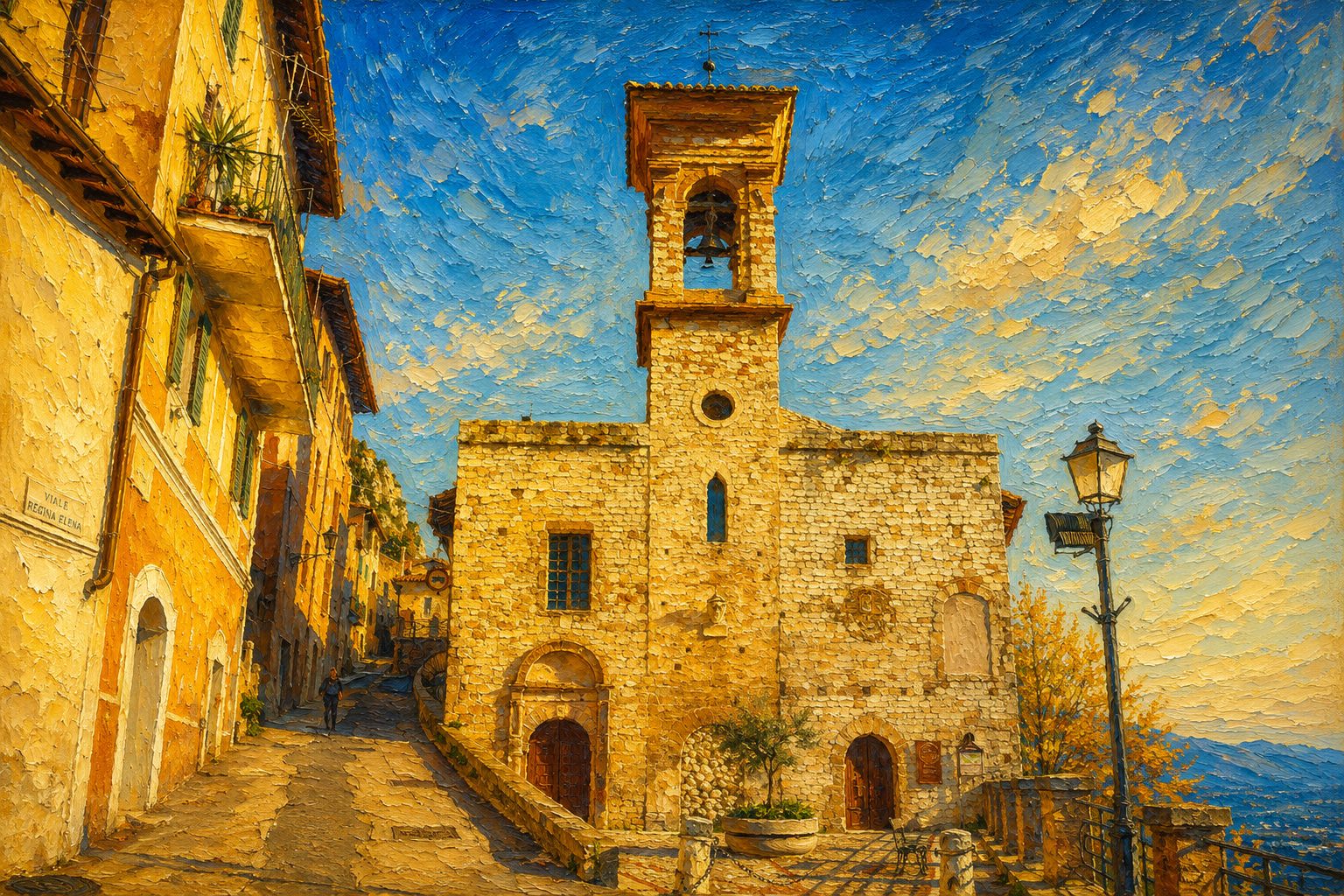
Church of Santa Caterina
Built in the middle of the '600, it was a church annexed to the Eustachi Palace which stands next to it.
The interior is embellished with paintings from the 17th century of unknown author. Here was the canvas of Girolamo Troppa depicting the Madonna and Child and the Saints.
Oratorio del SS. Sacramento
A Renaissance portal gives access to a single compartment: on the altar was placed a banner painted on the two faces depicting the Assumption of Our Lady and the Apparition of the Blessed Sacrament.
Church of St. Anthony
The ancient church remains a gothic vault with a beautiful fresco by Giovanni di Giovannello di Paolello and depicting the Calvary, a work dated 1425 of fine work, characterized by 75 figures.
Church of St. Agnes
It characterizes a beautiful baroque facade that appears beyond Carsulae street.
Once annexed to the Benedictine monastery. Baroque also the interior where you can admire a canvas of the '500 with the depiction of the "Martirio di Sant'Agnese".
Church of Santa Maria de Fora
According to some, the site has represented the primitive nucleus of the village of Cesi and was the seat of a Benedictine community.
By Romanesque setting, it uses many materials of karst origin.
Church of San Biagio
Nestled in a thick forest, the small church was built by the Contelori family on the site of an older oratory. Inside, in the apse, you can see an interesting fresco by Bartolomeo Barbiani, dated 1640, having by subject Cesi between the Saints Biagio and Carlo Borromeo.
Church of Our Lady of Painting
Probably erected in the '400 as a votive edict wanted by popular devotion, it was transformed in the '600. Located along the so-called Cesi's race, it is characterized by a small 3-pillar portico.
Inside a fresco depicting Angelo that brings the model of the church of Sant'Angelo executed by Bartolomeo Barbiani in the early 17th century.
Church of Sant'Onofrio
It was built in 1675 on the site of an ancient romitory immersed in the woods known as "bosco di Sant'Onofrio". It has only one nave: on the high altar you can admire what remains of polychrome stucco and two angels. Here was the statue of St. Onofrio, patron of the village.
Church of Sant'Erasmo
Overlooking the earthen basin in a splendid position, it has Romanesque architecture with portal adorned and contrasted to the sides. The inside has only one nave.
It was a Benedictine monastery dependent on Montecassino, perhaps erected in the 12th century on the site where the Rocca di Cesi stood and, as seen from the remains of the polygonal walls, on the site of the ancient center of the Umbrians.
Traditions and parties
The feast of San Biagio
The feast of San Biagio is held on February 3. On this occasion the Cesani, repeating an ancient custom, go to the place where they bless the candles and the holy oil and where they become snacks. The popular saying "To San Biagio de li tozzi, to me you help me to te strozzi" reminds me that San Biagio was the protector of the throat.
A curious bond
Sant'Erasmo is also known as Sant'Elmo. They are called "fires of Sant'Elmo" those luminous phenomena that occurred on the trees of the ships, that the ancient peoples, not knowing the atmospheric origin, attributed to the work of the mythical Dioscuri Castore Polluce. Precisely to the genelle deities of Castore and Polluce in Carsulae is dedicated a temple.
Also in this archaeological area there are two twins, saints Cosma and Damiano to whom the church is dedicated. The latter would represent a Christianization of the worship of the Dioscuri.

