
The Palaces
Spada-Stocchi Palace
Sixteenth century building with remarkable frescoes, especially on the noble floor, where you can see "Biblical scenes" and "Scene hunting". On the ground floor you can admire a beautiful fireplace: in the architrave are inserted names of Peter and Silvestro Spada patrons of the construction.
Theatre - former church of Sant'Andrea
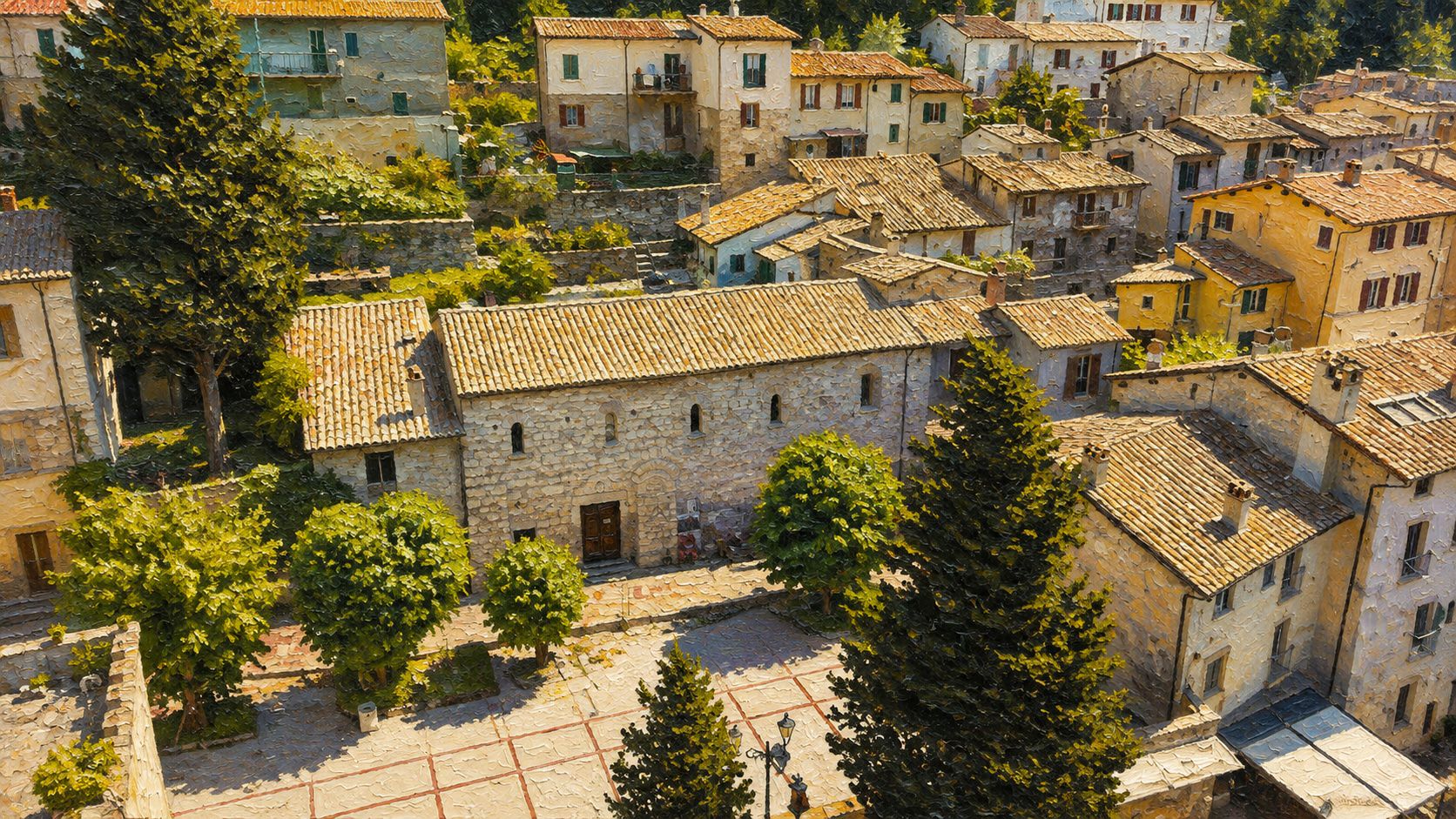
The original building belongs to the 12th century but was renovated in the 1500s with the addition of niches that served as chapels. In them, still visible, there are frescoes regarding Saint Lucia and Saint Augustine. Rests of frescoes are also found in the apse. Unconsecrated at the end of the 19th century, it was used as a theatre, a function which still takes place today along with a meeting place of the city community.
Of considerable interest the portals that overlook the flank embellished by bas-reliefs of karst origin.
Palazzo Cesi Cittadini
Notable for size and elegant by setting, the palace was erected in the '500.
It has two wings joined by a hanging body. Beautiful portal to a diamond tip bugnate. The interior has frescoed rooms and beautiful furnishings. A park is attached to the building.
He belonged to the illustrious family of the Cesi di Acquasparta to pass, in the 1800s, to the Cittadini di Terni.
Palazzo Contelori
The building shows a legally curvilinear front with a raised central part compared to the two wings. Beyond the portals opens an internal court. It was erected in the 17th century.
The most important son of the Contelori family was Giovanni Maria, an illustrious historian and author of the Memories of the land of Cesi, the main historical source of the events of the town. Until 1927 it was the municipal seat.
Palazzo Conti-Valentini
Aristocratic building located in Via Contelori with beautiful central portal flanked by two large terracotta blocks.
Eustachi Palace (formerly Pressio Colonnese)
Noble building built in the middle of the 17th century, characterized by an elegant access and a beautiful inner court surrounded by loggia. Some rooms bear traces of the ancient fresco and grotesque decoration.
About the Theatre
Inside a large one remembers that in this theater the famous baritone Titta Ruffo sang.
A tradition wants that in front of the square Federico Cesi preached San Bernardino da Siena.
The bas-reliefs of the portal are artefacts of Karulana origin.
They present various depictions. The most interesting is that reproduces an oleary anphora that attests how the territory, already in ancient times, was naturally invoked to the cultivation of olive trees and to the oil production.

